
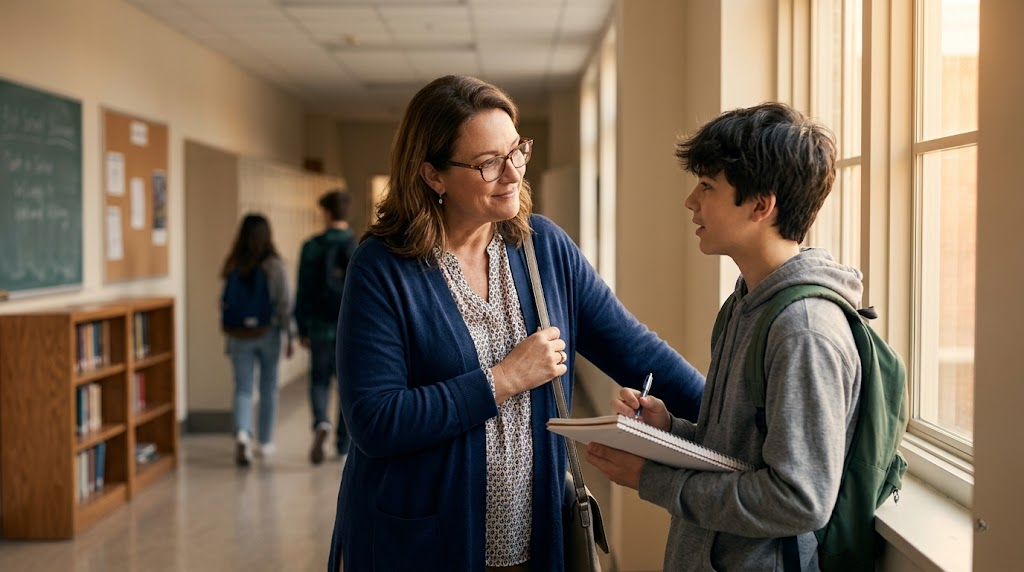
She taught you in Year Eight. You were thirteen, difficult, not particularly interested in anything she was saying. But something she said that year lodged somewhere and stayed. You probably did not even notice it at the time. Years later, when you were facing something hard, you heard her voice in your head, and you knew what to do.
The teacher who keeps teaching after the class ends
The influence of a formative teacher does not stop when the school year ends. Most people, if they think back carefully, can name the teacher who changed something for them. Not the one who taught them the most content. The one who taught them something about themselves.
That teacher is often retired now, or unreachable, or gone. And whatever they still had to say never made it out of the classroom.
That does not have to be how it ends.
What research tells us about great teachers
John Hattie, a researcher at the University of Melbourne, spent decades synthesizing the results of more than eight hundred meta-analyses on student achievement. His findings, compiled in Visible Learning, published in 2009 by Routledge, identified the quality of the teacher-student relationship as one of the most significant influences on learning outcomes. More significant than class size, more significant than school resources.
What Hattie’s research made clear is that the variable that matters most is not the curriculum or the school. It is the person standing in front of the class and the relationship they build. A great teacher carries influence that extends well beyond the formal setting and well beyond the academic subject they were paid to teach.
Recording for the student you can see clearly
A good teacher knows things about a student that the student does not know about themselves. They see the potential before it has become performance. They recognize the self-doubt that is masking real ability. They understand the specific obstacle between where this person is and where they are capable of going.
That insight rarely gets said. There is not always a moment in a busy school year to sit a student down and tell them exactly what you see in them. The observations stay in the teacher’s head, unuttered, until the student leaves the class and the chance is gone.
MessageFuture lets a teacher record those observations now and deliver them at a future date the student will actually be ready for. A message recorded today, scheduled for the year a student starts university, or five years into their career, or on the day they face the hardest thing they have faced so far. The words land when they can be heard.
Timeless messages for moments you cannot predict
Some of the moments when a student most needs to hear from a teacher cannot be scheduled in advance. The day they walk away from a path they should have stayed on. The moment their confidence collapses and they do not know why. The crossroads where they are making a decision you could have helped them see more clearly.
A Timeless message on MessageFuture has no fixed delivery date. You record it and designate a Guardian, someone the student trusts, who delivers it when the right moment comes. A message that says “if you are thinking about giving up on this, read what I wrote about what I saw in you” is not something a student finds in a textbook. It is the thing only their teacher could have said.
Preserving how a teacher thinks, not just what they said
MessageFuture’s AI Twin feature lets a teacher go one step further. Built from an eight-question personality questionnaire, an AI Twin is a cognitive digital proxy, a conversational model shaped by the teacher’s words, values, and way of thinking. Students can ask it questions and receive responses shaped by how the teacher actually approached problems, not a generic answer, but a reflection of that specific person’s mind.
This is not a replacement for the teacher. It is a way of preserving how they thought, so that something of their intellectual presence can keep meeting students who need it, long after the classroom is empty.
The lesson that was never delivered
If you are a teacher, there are things you know about your students that you have not said yet. There are observations still forming, insights you have been carrying, moments you meant to create and never quite found the time for.
You can record them now. You can start at MessageFuture, and let the words find the moment they were always meant for.
References
- Hattie, J. (2009). Visible Learning: A Synthesis of Over 800 Meta-Analyses Relating to Achievement. Routledge.
- Pianta, R.C., Hamre, B.K., & Allen, J.P. (2012). Teacher-student relationships and engagement. In S.L. Christenson et al. (Eds.), Handbook of Research on Student Engagement. Springer.
Ready to start? Build a Twin your family can talk to, add a cloned voice so it answers aloud, and add memories it can bring up when they matter. Create a free MessageFuture account.