
He coached the team for twenty-two years. He was at every major match, every selection crisis, every moment the players were not sure they could do what was being asked of them. Then he retired. The squad kept playing. And three years later, one of his former players sent him a message to say she had just made the national team, and she wished she could have told him in person the way he always told her she would get there.
What a great coach builds that outlasts the coaching
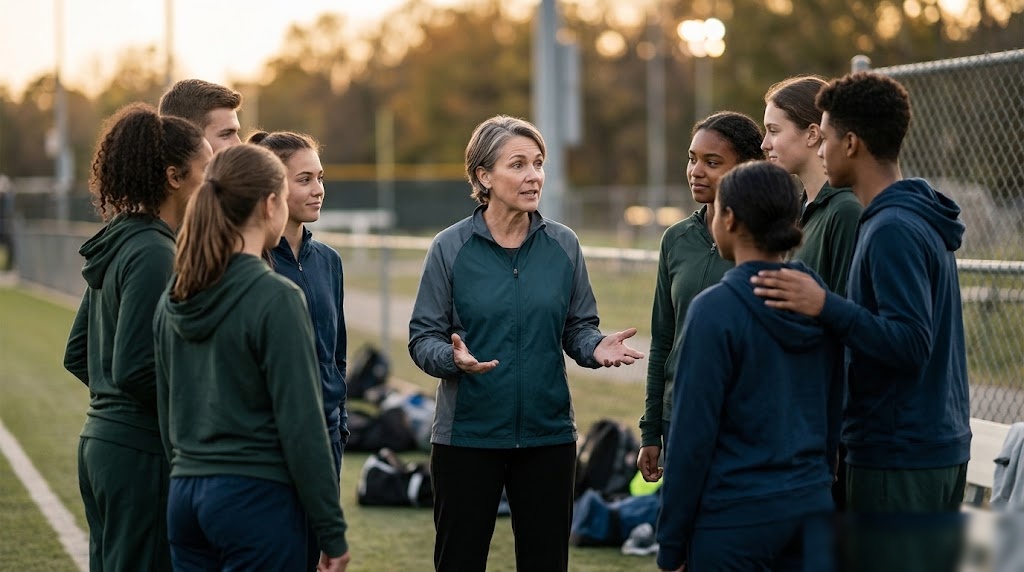
A coaching career is not measured in seasons. The real measure is what the athletes carry with them when the formal relationship ends. The habits of mind a coach installs. The standard they hold their players to when no one is watching. The voice an athlete hears in their head at the critical moment, years after the last session.
That voice is the coach’s most lasting contribution. And it often goes unrecorded.
What research tells us about long-term athletic influence
Benjamin Bloom, a researcher at the University of Chicago, studied the development of exceptional talent across multiple fields, including sport, in his 1985 work Developing Talent in Young People. Bloom’s research identified a consistent pattern: the coaches who shaped elite performers most deeply were not necessarily the most technically sophisticated. They were the ones who transmitted belief, sustained commitment, and built a relationship that the athlete internalized.
That internalized relationship is what keeps operating after retirement. What Bloom’s work suggests is that the message a coach sends is not a one-time transmission. It is a model the athlete runs inside themselves for the rest of their career.
Scheduled messages for milestones you can predict
A coach who knows their athletes well knows which milestones are coming. The year a young player will go through their first real selection process. The age at which the physical demands of training start to require a different kind of mental resilience. The first season when the athlete is no longer the youngest in the squad and has to figure out what kind of leader they are.
MessageFuture lets a coach schedule a message for any specific future date, up to thirty years away. A voice note recorded today, delivered the morning of a national trial. A video recorded before retirement, set to arrive on a player’s thirtieth birthday with a reflection on what the coach saw in them at twenty. The coaching continues, even when the coach no longer can.
Timeless messages for moments that cannot be planned
Not every important moment in an athlete’s career can be dated. The injury that threatens to end a promising run. The selection cut that goes the wrong way. The day a player is not sure the sport still feels worth it.
A Timeless message has no fixed delivery date. A coach records it, designates a Guardian, and that Guardian delivers it when the moment arrives. A fellow coach, a trusted assistant, a long-term team manager who stays close to the squad. The message is specific: “play this when she is thinking about walking away.” It arrives when it needs to.

The AI Twin for the coach who wants to keep being a resource
MessageFuture’s AI Twin feature goes further still. Built from an eight-question personality questionnaire, an AI Twin is a cognitive digital proxy shaped by the coach’s way of thinking, the way they approached problems, the questions they always asked, the perspective they brought to pressure situations. Athletes can engage with it directly, asking questions about situations the coach would have had a view on.
This is not a replacement for the coach. It is a way of preserving how the coach thought, so that something of their approach to the game can keep helping players who need it, long after the sessions have ended.
The career that keeps contributing
Retirement ends the formal role. It does not have to end the impact.
A coach who records before they leave is not holding on. They are doing what great coaches have always done: preparing their athletes for the moments they cannot be present for. You can start recording at MessageFuture, and let your words keep arriving long after the final whistle.
References
- Bloom, B.S. (Ed.). (1985). Developing Talent in Young People. Ballantine Books.
- Cote, J., & Gilbert, W. (2009). An integrative definition of coaching effectiveness and expertise. International Journal of Sports Science & Coaching, 4(3), 307–323.
Ready to start? Build a Twin your family can talk to, add a cloned voice so it answers aloud, and add memories it can bring up when they matter. Create a free MessageFuture account.