
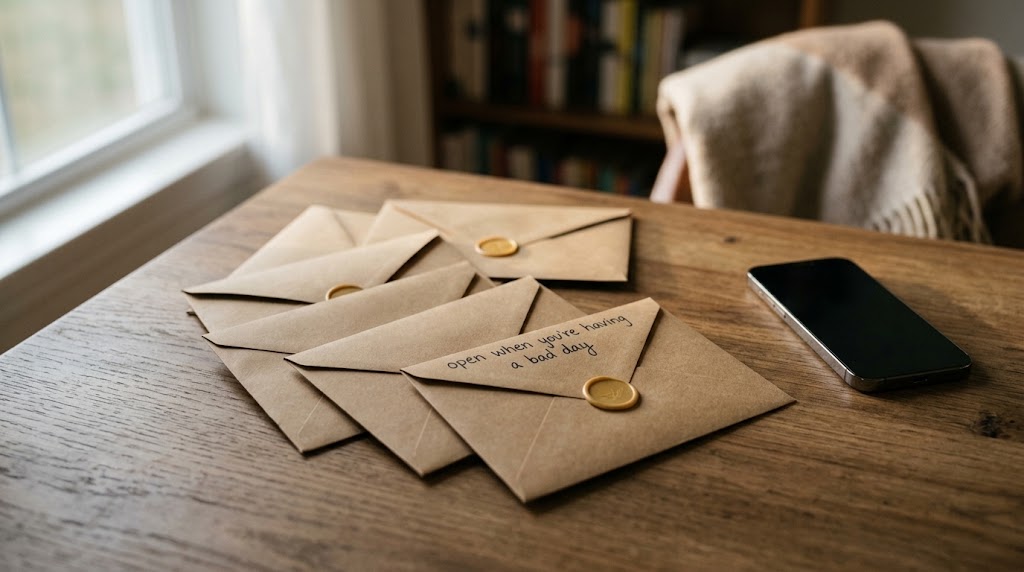
Why are “Open When” letters everywhere on TikTok right now? Because they solve something paper can’t: knowing someone thought of you specifically, on the exact day you needed it. MessageFuture does the same thing, except instead of a sealed envelope, it’s your actual voice or face, scheduled or held for the moment that fits.
If you haven’t seen the trend, the idea is simple. You write a stack of letters in advance, each one labeled for a specific moment, “open when you miss me,” “open when you’re having a bad day,” “open when it’s our anniversary,” and hand them over sealed. The person holds onto the stack and only opens each one when its label actually applies. It’s popular for long-distance couples especially, and for good reason.
Why the Trend Took Off With Long-Distance Couples Specifically
Distance changes what communication has to do. You can’t just be in the room when something goes wrong, so the next best thing is making sure something arrives at the right moment anyway, chosen in advance, by you, for exactly that situation. An “Open When” letter is a way of being specific about a future moment you can’t attend in person.
Research on long-distance dating relationships backs up why this kind of intentional, forward-planned contact matters so much. Stafford and Merolla (2007), publishing in the Journal of Social and Personal Relationships, found that long-distance couples often report more relational stability than geographically close couples during periods of separation, tied closely to how satisfied they are with the quality of communication they maintain, not just the frequency. A letter written specifically for a future moment isn’t just contact, it’s the kind of deliberate, high-quality communication that research shows actually holds a long-distance relationship together.
Where Paper Actually Runs Out
The letters themselves are genuinely thoughtful. But paper has real limits once you look closely. You can’t hear a voice crack, or catch an expression, both of which carry more than the words alone. A letter can get lost, damaged, or left behind during a move. And once it’s written, it’s fixed, if the right moment turns out to be two years away instead of six months, there’s no way to adjust it, and no way to add a new one for a label you didn’t think of yet.
None of that makes the tradition worse, it explains why the same idea works even better recorded than written.
What This Looks Like as a Recording Instead
The core idea carries over completely, a message made now, for a specific future moment, held until it applies. MessageFuture just changes the format and removes the physical limits. Record it as text, a voice note, a photo, or a full video, whichever actually carries what you mean to say. Set an exact date if you know it, your next anniversary, the day they land after a long trip. Or mark it Timeless if you don’t, “when you’re having the kind of day that needs this,” with no date attached, released whenever that day actually comes.
What to Actually Say
The letters that get reread aren’t the ones with the most poetic language, they’re the specific ones. Mention the actual thing you’re picturing, not a general sentiment. Instead of “I miss you,” try naming the exact moment you’re picturing when you say it, what you’d be doing together if the distance weren’t there. Instead of “I’m proud of you,” name the specific thing you watched them push through. Specificity is what makes someone believe the message was made for them and not copied from a template.
For the Moments You Can’t Predict
Some of what you want to say doesn’t have a date attached to it yet. “The day we’re finally in the same city” doesn’t have a date on a calendar until it suddenly does. That’s exactly what a Timeless message is for, no delivery date required. You release it yourself once the moment actually arrives, or if something happens and you’re not able to, a Guardian you’ve named can release it on your behalf. Either way, it still reaches them.
It Doesn’t Have to Be Only for the Hard Days
The “Open When” format tends to skew toward comfort, “open when you’re sad,” “open when you doubt yourself.” Worth recording the good ones too. A message for the morning of a reunion. One for when the distance finally ends for good. The habit of recording something for a future moment works just as well for anticipation as it does for comfort.
Keeping Track of More Than One
The paper version relies on a physical stack sitting in a drawer, sorted by whatever label is visible on the outside. That works until the stack gets thick, or a letter slides out of order, or you can’t remember which ones you’ve already used. A recorded version doesn’t have that problem. Every message you make sits in your MessageFuture history with its own label, its own recipient, and its own status, sent, scheduled, or still waiting as Timeless, so you can see at a glance what’s already out there and what still needs a moment attached to it.
That matters more the longer this goes on. Six months into a long-distance stretch, remembering which letter covers which situation gets genuinely hard to track on paper. A digital version scales with however many you end up making, without needing a bigger drawer.
Common Questions
Do I need to record a whole stack at once, like the paper version? No. Record one whenever something occurs to you, there’s no need to sit down and plan out an entire set in one sitting the way the paper trend suggests.
What if the relationship isn’t long-distance, does this still make sense? Completely. Distance makes the need for this obvious, but a specific message for a specific future moment matters in any relationship, close or far.
Can I schedule one and also leave one Timeless? Yes, most people do both, dated messages for moments you already know are coming, Timeless ones for whatever you can’t put a date on yet.
Can I make one for a friend or family member, not just a partner? Yes, nothing about this is limited to romantic relationships. The same idea works for a best friend moving away, a sibling, or a parent, anyone you’d want to reach at a specific future moment.
What’s the actual difference between a Scheduled and a Timeless one here? Scheduled means you already know the date, an anniversary, the day they land after a trip, and it arrives automatically on that day. Timeless means you don’t know the date yet, “when you’re having a hard day,” so nothing goes out until you personally decide the moment has come.
What does it cost to start? The free plan includes 10 credits to try it. Paid plans start at $4.99 a month for more credits and longer scheduling.
You can record your first one at MessageFuture, it takes about five minutes.
References
- Stafford, L., & Merolla, A.J. (2007). Idealization, reunions, and stability in long-distance dating relationships. Journal of Social and Personal Relationships, 24(1), 37–54.
- Merolla, A.J. (2012). Connecting here and there: A model of long-distance relationship maintenance. Personal Relationships, 19(4), 775–795.
Some words are worth keeping for later.
MessageFuture lets you schedule letters, voice notes, and videos for the people you love, delivered exactly when the moment comes.