
The night before the competition, she could not sleep. Four years of training for a morning that was now twelve hours away. She was not ready, she decided. The preparation was not enough. Everything she had built felt suddenly fragile. She recorded a voice message to herself at 2 a.m. and scheduled it to arrive the moment she crossed the finish line.
The part of the story that gets lost
When an athlete tells the story of their achievement, they start from the finish line. The time on the clock, the placement, the feeling at the end. The crowd, the medal, the first phone call home.
The night before is not part of the story. The fear is not part of the story. By the time there is something worth telling, the difficulty of the attempt has already compressed. The specific terror of the night before, the version of you that was not sure, the questions you could not answer at 2 a.m. are already fading.
Recording that version is the only way to keep it.
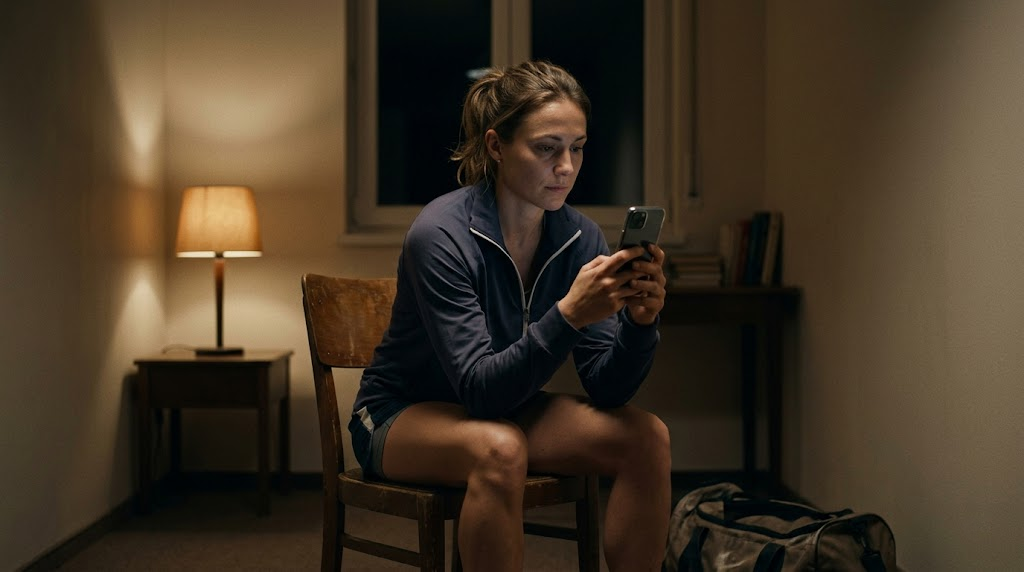
What sports psychology tells us about pre-competition anxiety
Athanasios Hatzigeorgiadis and colleagues at the University of Thessaly conducted a meta-analysis of self-talk research in sport, published in Perspectives on Psychological Science in 2011. Their findings showed that deliberate verbal self-communication, particularly when it is instructional and motivational, meaningfully improves athletic performance under competitive conditions.
What the research also shows is that the athlete who engages with their own internal dialogue, rather than suppressing it, is better equipped for the moment of competition. The fear is not an obstacle to performing. Treated deliberately, it is part of the preparation.
Recording what you feel the night before is not self-indulgence. It is engagement with the most honest part of the process.
The message from your most honest self
The version of you that records the message the night before a competition is not the composed version. It is not the version that has already won. It is the version that is still trying to believe it is possible, still reasoning through the doubt, still building the case for showing up in the morning.
That version is telling the truth. The version that crosses the finish line will be someone different, changed by the experience, looking back from the other side. But the message recorded in the fear captures what the achievement actually required. And it carries something the finish-line version cannot manufacture: the proof that you were uncertain, and you showed up anyway.
Using FutureMe to send the before to the after
MessageFuture‘s FutureMe feature lets you record a message today and schedule it for a specific future date. A voice note recorded at 2 a.m. the night before a marathon, scheduled to arrive the evening after the race. A video recorded the morning of a try-out, delivered the day the selection results are announced.
When the message arrives, you will be a different person in a different moment. What you wrote or said before will feel like it came from someone you once knew, but the recognition will be immediate. You will remember exactly what that felt like. And you will understand something about what you just accomplished that the achievement itself cannot tell you.

For the athlete who already knows how this goes
If you have competed before, you know the pattern. The doubt before. The different person who finishes. The strange feeling of looking back at how scared you were.
Record the before. Not for anyone else. For the athlete who will cross that finish line and need to understand what it cost.
You can start at MessageFuture. The message waits until the date you choose. Then it finds you.
References
- Hatzigeorgiadis, A., Zourbanos, N., Galanis, E., & Theodorakis, Y. (2011). Self-talk and athletic performance: A meta-analysis. Perspectives on Psychological Science, 6(4), 348–356.
- Hardy, L., Jones, G., & Gould, D. (1996). Understanding Psychological Preparation for Sport: Theory and Practice of Elite Performers. Wiley.
Ready to start? Record your first message in a few minutes, in text, audio, image or video, choose whether it arrives on a date you pick or when the moment comes, and nominate Guardians so it still arrives whatever changes in between. Create a free MessageFuture account.