
He recorded it in the seventh month. His partner was asleep. The house was quiet. He sat in the room they had been setting up for weeks, held his phone, and started talking to someone who had not arrived yet. He did not know her name. He did not know her face. He knew exactly what he wanted to say to her on the day she was old enough to hear it.
The love that comes before the person
There is a particular kind of love that exists before a child is born. Not abstract. Not general. Specific, and already shaped by everything the parent imagines and hopes and fears about the person who is coming. Parents name this person before they can be held. They speak to them, prepare for them, make decisions on their behalf before they have a voice.
That love is already real. And it almost never gets recorded.

What research tells us about prenatal attachment
John Condon, a researcher and professor of psychiatry at Flinders University in South Australia, developed one of the first validated measures of prenatal attachment in the early 1990s. His work, published in the British Journal of Medical Psychology in 1993, found that parents develop genuine emotional bonds with their unborn child, bonds that are specific, directional, and experienced as real relationships, not projections.
What Condon’s research established is that the emotional reality of being a parent begins before birth. The love that exists in the seventh month of pregnancy is not a rehearsal for the real thing. It is the real thing, expressed in a different form. And like all real things, it is worth preserving.
Recording what you feel before you know who they are
A message recorded before a child arrives captures something no later recording can. It holds the parent before the relationship changed them. Before the sleepless nights, the first word, the first school year, the first argument. Before all of it shaped them into the parent they became.
It holds the specific version of love that exists in anticipation. The hope that has not yet encountered the reality. The promise made to someone you cannot see yet. That version of the parent is unrepeatable. It exists only in the window before the child arrives and everything changes.
A Timeless message waiting for the right moment
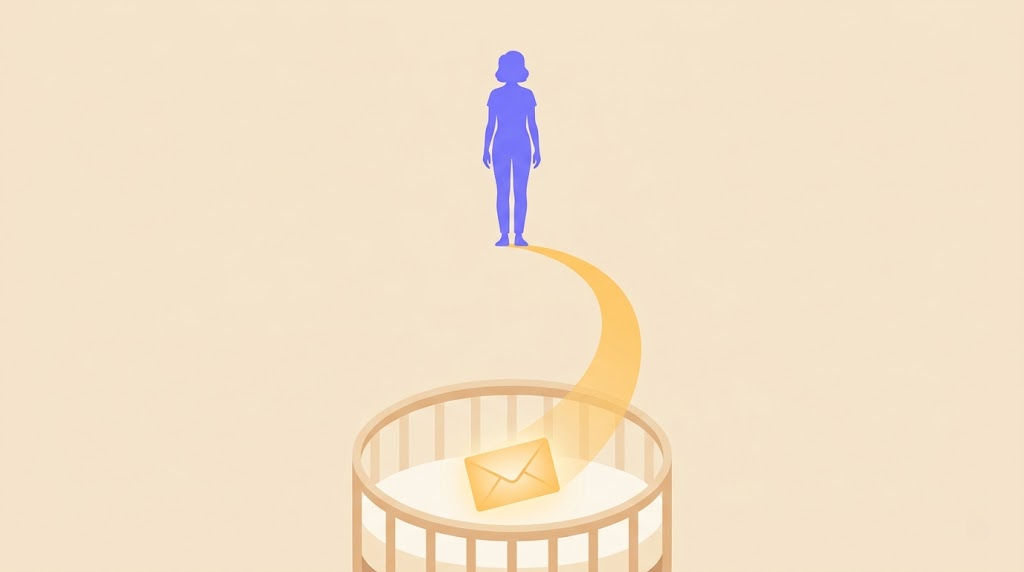
A Timeless message on MessageFuture has no fixed delivery date. You record it now, designate a Guardian, and the message waits. Your Guardian is a trusted person you choose, someone who understands what the message is and when it should be delivered.
A parent recording before a child is born can set the message for any future moment the Guardian recognizes: a graduation, a marriage, a time of real difficulty, a milestone the parent may or may not be there to witness in person. The Guardian ensures the message finds its moment, even when the parent cannot.
You can also schedule it. MessageFuture lets you set a delivery for a specific future date, up to thirty years away. If you want your child to hear this at eighteen, at twenty-five, at thirty, you can set it now and know it will arrive.
What to say when you do not yet know who they are
You do not need to know who they will become to say something real. You know who you are. You know what you believe, what you value, what you have learned that cost you something. You know the things you hope for them even though you cannot yet imagine the specifics.
Record what you believe about the world and about people. Tell them what kind of love you had before they arrived. Say what you were afraid of and what you were sure of. Tell them what it felt like to be waiting for them.
That is what they will want to hear one day: not who you hoped they would be, but who you were when you were still hoping. You can start that recording now at MessageFuture.
References
- Condon, J.T. (1993). The assessment of antenatal emotional attachment: Development of a questionnaire instrument. British Journal of Medical Psychology, 66(2), 167–183.
- Klass, D., Silverman, P.R., & Nickman, S. (Eds.). (1996). Continuing Bonds: New Understandings of Grief. Taylor & Francis.
Ready to start? Record a message with no date set, release it yourself when the moment arrives, and nominate Guardians who can do it for you if you are not there. Create a free MessageFuture account.