
Is it okay to build an AI version of someone after they’ve died? Most of the real discomfort around AI “grief bots” isn’t about the technology, it’s about consent. When a version of someone is built from scraps left behind, without them ever agreeing to it, that’s a different thing entirely from someone building their own AI Twin themselves, while they’re here to choose it.
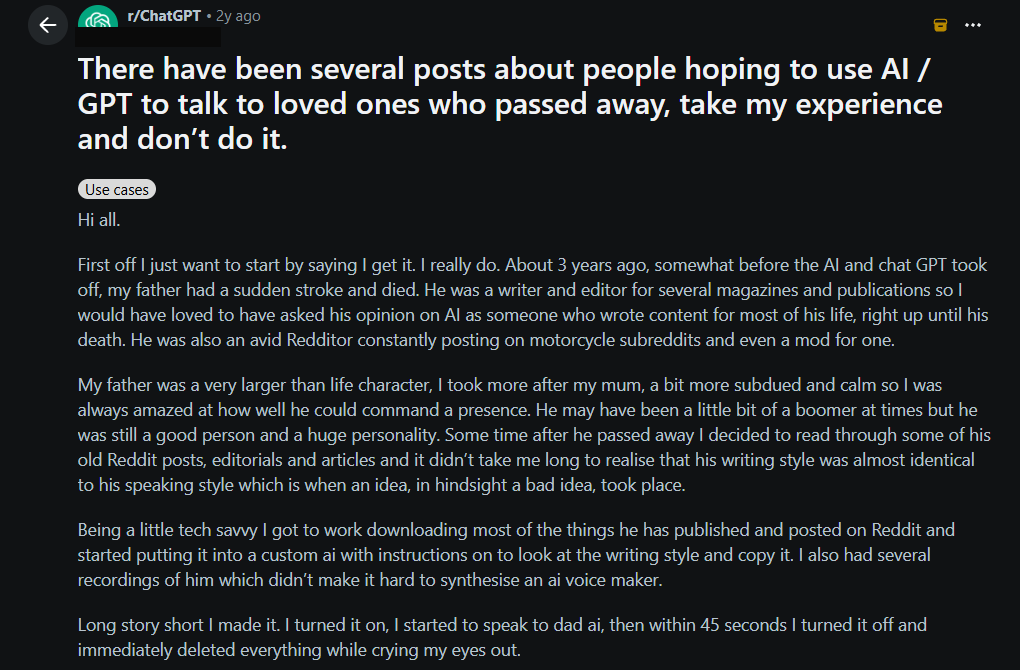
One of the most upvoted threads on this exact question isn’t theoretical. In a post on r/ChatGPT, someone describes what happened after his father died of a sudden stroke. His father had been a writer and editor his whole life, and an active Redditor. “Being a little tech savvy I got to work downloading most of the things he has published and posted on Reddit and started putting it into a custom ai with instructions to look at the writing style and copy it. I also had several recordings of him which didn’t make it hard to synthesise an ai voice maker.” He built it without ever asking his father, because his father was no longer there to ask.
What happened next is the part worth sitting with. “Long story short I made it. I turned it on, I started to speak to dad ai, then within 45 seconds I turned it off and immediately deleted everything while crying my eyes out. It was too good. I immediately recognised that this was bad and I could feel my own desire to speak to my father but this was not him. It sounded, spoke, and even reasoned very close to him but it was not him.” He wasn’t scared because it failed. He was scared because it worked, and because nobody, including the person it was modeled on, had ever agreed to it existing.
The Real Distinction Researchers Actually Use
A 2024 paper in Philosophy & Technology, by researchers Tomasz Hollanek and Katarzyna Nowaczyk-Basińska at the University of Cambridge’s Leverhulme Centre for the Future of Intelligence, maps out exactly why this category of technology raises such different reactions in different people. Their framework separates three roles that most “deadbot” discussions blur together: the data donor (the person whose words and voice are actually used), the data recipient (whoever holds that data after the donor is gone), and the service interactant (whoever ends up talking to the result).
In most of the uneasy cases people describe online, the data donor never actually agreed to any of it. A grieving family member becomes the data recipient by default, assembling a version of someone from texts, voicemails, and old photos, and makes the decision to build something the person being rebuilt never chose. That gap, between who’s represented and who actually consented, is where most of the real discomfort comes from.
Why MessageFuture’s AI Twin Is Built the Other Way Around
An AI Twin only exists if the person it’s modeled on built it themselves, while they were here to do it. There’s no version where a family member assembles one afterward from old messages. The data donor and the person making the decision to create it are always the same person, which removes the exact gap the research identifies as the real source of harm.
It’s built from an 8-question personality questionnaire the person answers directly, not scraped from their old messages or social media, and a cloned voice is only ever added from a recording that person made themselves, specifically for this. It’s a cognitive digital proxy, built from their own answers and their own words, a way to preserve how someone thought, spoke, and felt, not a replacement for them and not an attempt to recreate someone who never agreed to be recreated.
What “Close to Your Voice” Actually Means
Worth being precise about this, since overpromising here is exactly how trust gets lost in this category. A cloned voice is close to the person’s own, not identical to it, modelled on a short recording they make themselves. Nobody using an AI Twin should walk away thinking a listener couldn’t tell the difference. The honesty is the point, not a limitation apologized for.
Where the Discomfort Online Is Actually Pointing
Reading through the real threads on this, the sharpest reactions aren’t really about AI being used to preserve a person. They’re about the absence of that person’s own choice in the matter. One Reddit discussion on grief bots put the risk plainly, weighing whatever private comfort it offers against the real possibility of confusing a representation with the actual person who’s gone. That’s a legitimate concern, and it’s one that only exists when the thing being interacted with was built without the person’s own participation.
An AI Twin someone builds for themselves, with full knowledge of what it is and isn’t, doesn’t carry that same risk in the same way, because the person who’ll eventually be represented by it is the one who decided what it should say, in their own words, while they were here to decide.
Common Questions
Can a family member create an AI Twin of someone after they’ve passed? No. An AI Twin can only be built by the person it represents, while they’re able to complete the questionnaire and, if they choose, record a voice sample themselves.
Does the AI Twin sound exactly like the real person? No. A cloned voice is close to the person’s own, not identical, and is only ever built from a sample that person recorded themselves.
Is an AI Twin meant to replace the person who’s gone? No. It’s a way to preserve how someone thought, spoke, and felt, so the people who love them can still ask questions, not a substitute for the person themselves.
Some words are worth keeping for later.
MessageFuture lets you schedule letters, voice notes, and videos for the people you love, delivered exactly when the moment comes.