
Your grandmother knew something about keeping a marriage together through difficult years that your therapist charges by the hour to approximate. Your grandfather had a way of thinking about failure that took him through three decades of work without bitterness, and he never quite explained it because no one quite asked. Now they are gone, and those things are gone with them. Not because anyone failed. Because no one made the recording.
The knowledge that lives in one person
Grandparents hold a specific kind of knowledge that no book contains. Not information. Not opinion. Knowledge earned through decades of the actual experience of being alive: raising children, surviving difficulty, staying in a relationship through the parts that are not romantic, watching the world change and deciding what to keep and what to let go.
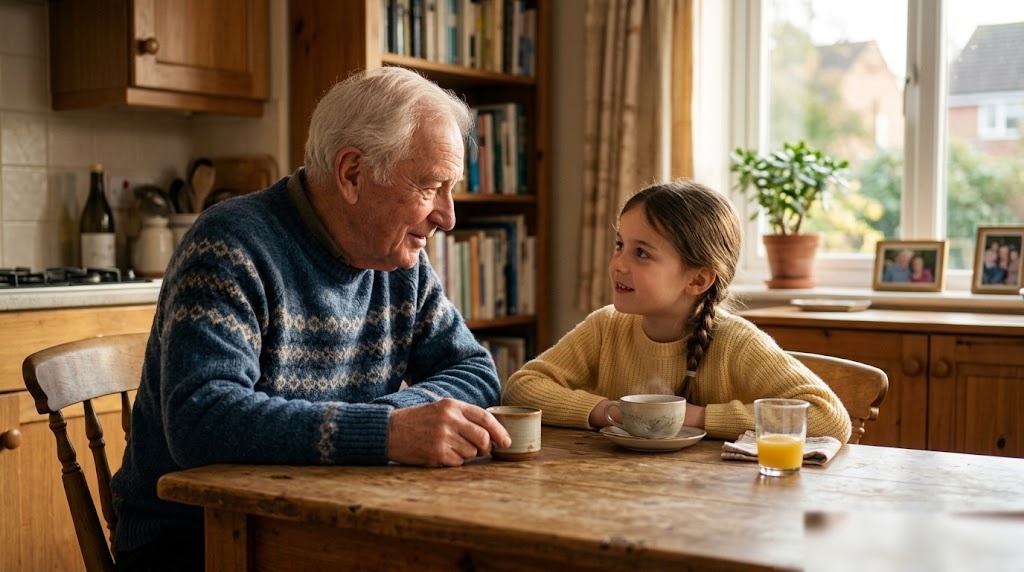
This knowledge is rarely transferred deliberately. It lives in incidental conversations, in offhand remarks at the kitchen table, in the way a grandparent responds to something difficult in a way that makes you realize they have seen it before. It is almost never recorded. And when the person who holds it is gone, it goes with them completely.
What narrative research tells us about family stories
Robyn Fivush, a professor of psychology at Emory University, has spent decades studying the effect of family narratives on child development. Her research found that children who know more about their family’s history, including the difficulties, the setbacks, and how the family navigated them, demonstrate stronger resilience, better emotional regulation, and a more stable sense of identity.
What Fivush’s work shows is that knowing where you come from is not just sentimental. It is functional. A grandchild who understands how their grandparent approached adversity has access to a model they can actually use. The stories are not just heritage. They are tools.
Recording the stories that would otherwise go unasked
The conversations that contain the most valuable things often never happen because no one thinks to start them. Grandchildren are busy with their own lives. Grandparents do not want to seem as though they are lecturing. The assumption on both sides is that there will be more time.
MessageFuture lets a grandparent start the recording without waiting for the right conversation to happen. A video recorded today in their own voice, carrying the things they have always wanted to say but never found the right moment for. The story of the hardest year. The thing they learned about people that took decades to understand. The advice they wish someone had given them at twenty-five.
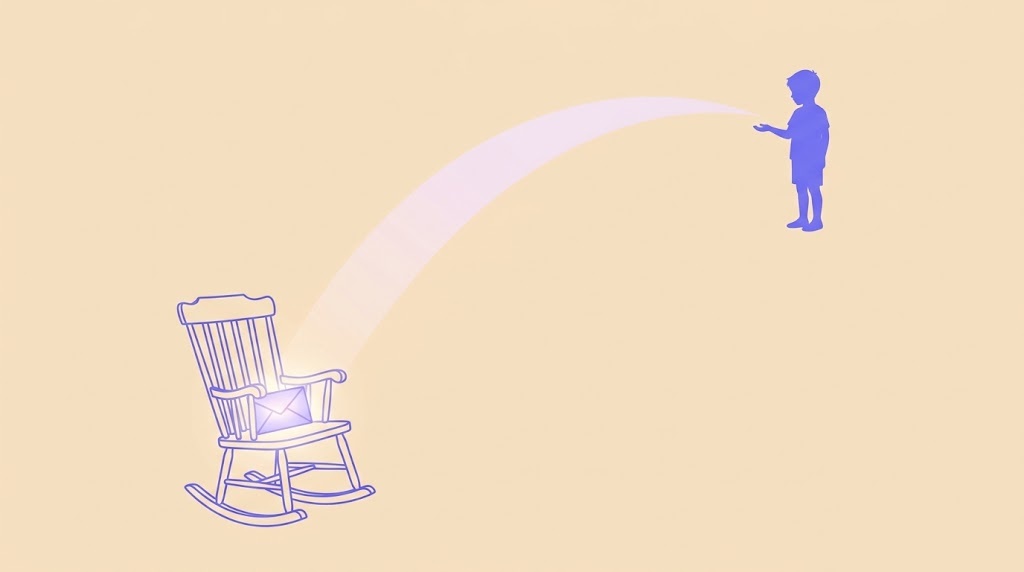
Scheduled messages let a grandparent set these recordings for specific future dates: when a grandchild graduates, turns thirty, has a child of their own. Timeless messages, held by a Guardian, deliver them when the moment arrives unexpectedly, and a grandparent’s voice meets a grandchild at the moment they most need what their grandparent always knew.
Preserving how a grandparent thought, not just what they said
MessageFuture’s AI Twin feature offers something further. Built from an eight-question personality questionnaire, an AI Twin is a cognitive digital proxy shaped by the grandparent’s way of engaging with the world: how they reasoned through problems, what they valued, the questions they asked, the perspective they brought to difficulty. A grandchild can interact with it directly, receiving responses shaped by how their grandparent actually thought and communicated.
This is not a replacement for a person. An AI Twin is a conversational model trained on their words and memories, a way of preserving how someone thought and spoke, not a resurrection or a substitute for presence. But it means that something of the grandparent’s way of engaging with the world can remain available for grandchildren who were too young when they were alive, or who did not yet know what to ask.
The recording they will be grateful for
Grandchildren grow into the age where they understand what their grandparents knew. Often that happens after the grandparent is gone. The questions that matter most arrive too late for the person who would have known how to answer them.
A recording changes that. The wisdom that has always been available, but never quite asked for, can be preserved today. You can start at MessageFuture, and let the knowledge that lives in you find the people who will need it long after you have passed it on.
References
- Fivush, R., Habermas, T., Waters, T.E.A., & Zaman, W. (2011). The making of autobiographical memory: Intersections of culture, narratives and identity. International Journal of Psychology, 46(5), 321–345.
- Duke, M.P., Lazarus, A., & Fivush, R. (2008). Knowledge of family history as a clinically useful index of psychological well-being and prognosis: A brief report. Psychotherapy: Theory, Research, Practice, Training, 45(2), 268–272.
Ready to start? Build a Twin your family can talk to, add a cloned voice so it answers aloud, and add memories it can bring up when they matter. Create a free MessageFuture account.