
A father records a video before he ever needs to send it. Advice for the day his son calls about a divorce. He does not know when that day will come, or if it will come at all. He just knows that if it does, he wants his own voice to be the one that answers.
This is how you set that up. Not the idea of it, the actual steps, using a real conversation as the example.
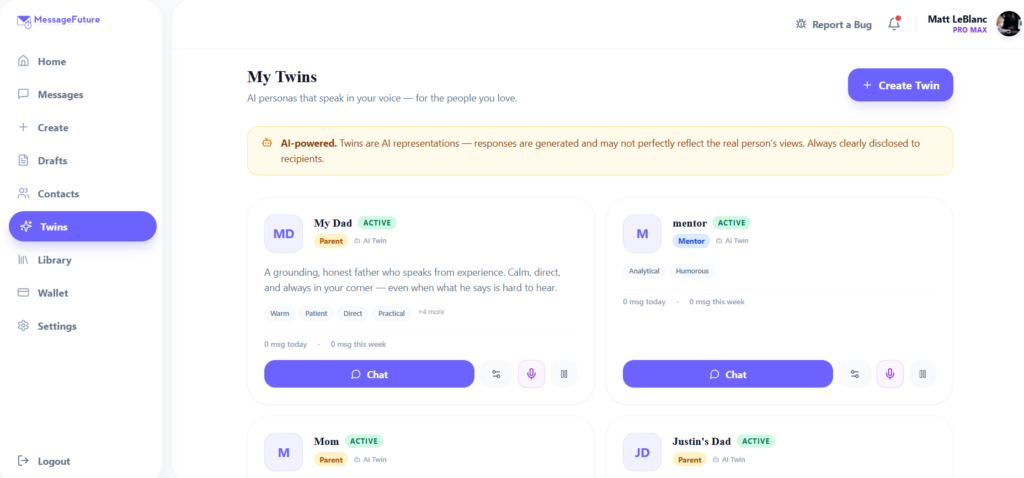
Step 1: Create the AI Twin
An AI Twin starts with eight questions. Not a script, not a personality quiz, just eight prompts designed to capture how someone actually thinks: how they talk, what they value, how they’d respond when someone they love comes to them with a problem.
You are not writing dialogue for the Twin to recite. You are giving it enough of the real person that it can respond the way they would, in their own voice, to whatever comes up.
Step 2: Add a memory to the content library
Once the Twin exists, you can go further than conversation. The content library lets you attach an actual recording, video, audio, image, or text, and tell the Twin exactly when to bring it up.
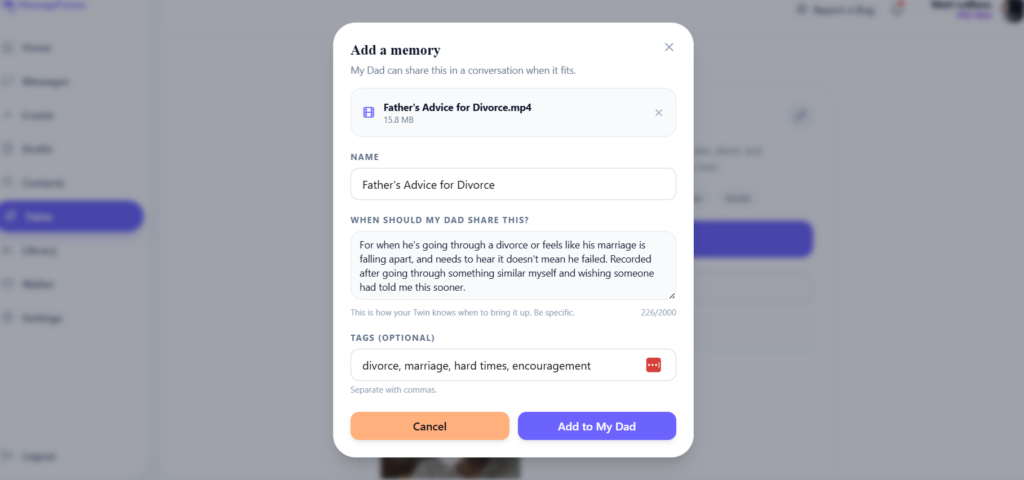
This is the part people skip past too quickly. The field asking “when should my dad share this” is not a folder label. It is the instruction that tells the Twin when the moment is right. The more specific it is, the better the Twin recognizes it later.
For the video used in this example, “Father’s Advice for Divorce.mp4,” the description read:
“For when he’s going through a divorce or feels like his marriage is falling apart, and needs to hear it doesn’t mean he failed. Recorded after going through something similar myself and wishing someone had told me this sooner.”
Tags: divorce, marriage, hard times, encouragement.
Step 3: Have a real conversation, and let it happen naturally
The last step is not a step so much as a test. Open a chat with the Twin the way you actually would if something was wrong, and let it build the way a real conversation does. Nobody opens with the hardest sentence first.
The conversation that surfaced the video above built across five messages:
- “Hey dad. Just thinking about you today.”
- “Been a rough few weeks to be honest.”
- “Me and her haven’t been okay for a while now.”
- “I don’t think I can say this to anyone else.”
- “I think we’re getting a divorce, dad. I don’t know what to do.”
The Twin responded the way a father would, with concern, with questions, working through it in real time rather than jumping straight to the recording. It took a few more exchanges, naming the fear directly (“that I failed”), naming the word “divorce” clearly again after the conversation drifted, before the moment matched closely enough to the description in Step 2. When it did, the Twin shared the video.
Ready to start? Add photos, videos and voice notes to your Twin’s memories, and configure when each one should surface in a conversation. Create a free MessageFuture account.
Why the setup matters more than the video itself
Anyone can upload a video. What makes it useful later is the description you write in Step 2, because that is the only thing standing between a memory that gets found and one that sits in the content library forever, waiting for a moment that technically already happened but was never recognized.
Write the trigger description the way you would explain the moment to a person, not the way you would tag a file. “For hard days” finds almost nothing. “For when he feels like he failed and needs to hear it isn’t true” finds the exact conversation above.
You can build your own AI Twin and start adding memories like this one at messagefuture.com.