
Somewhere in the last few years, you stopped being able to picture exactly how your grandmother’s laugh sounded. You remember that you loved it. You cannot reconstruct it. That is not a failure of memory, it is what happens to every voice that is never recorded on purpose.
Most people only think about this after it is too late to do anything about it. MessageFuture’s voice cloning changes when that choice has to happen, from a scramble after loss to a decision you make now, while your voice is still yours to give.
Why a Voice Carries What Words Alone Cannot
The brain treats voice as its own category of information, not just speech with a wrapper around it. Belin, Zatorre, Lafaille, Ahad, and Pike (2000), in a study published in Nature, identified voice-selective regions in the human auditory cortex, areas of the brain that respond specifically to the human voice, independent of the words being said. A transcript of what your father once told you is information. Hearing it in his actual voice activates something a transcript cannot reach.
This is the gap between MessageFuture’s original AI Twin, which responded in text, and what voice cloning adds to it. The words were already meaningful. The voice is what makes them feel like they are coming from the person, not about the person. A written “I’m proud of you” and the same four words in a parent’s actual voice are not the same message, even though the text is identical.
What You Need Before You Start
You do not need a studio, a script, or a second attempt at sounding like yourself. You need about ten minutes, a quiet room, and your phone. Background noise is the only thing that meaningfully affects the result, so a closed door matters more than any piece of equipment.
You also do not need to know yet what you will eventually say. The voice sample and the message content are separate steps. You are banking the sound of your voice now, and deciding what it says later, possibly years later, whenever the right message occurs to you.
How Voice Cloning Works Inside MessageFuture
The flow is built to be short enough that you actually finish it, and specific enough that the result sounds like you rather than a generic narrator.
Step 1: Record your voice samples. Inside the AI Twin setup, you read a short set of prompts aloud, directly in the app. There is no studio setup required, a quiet room and a phone microphone is enough.
Step 2: Complete your AI Twin’s 8-question personality questionnaire. This is the same step that shapes how your Twin thinks and responds. Voice cloning attaches to this existing profile rather than creating a separate one.
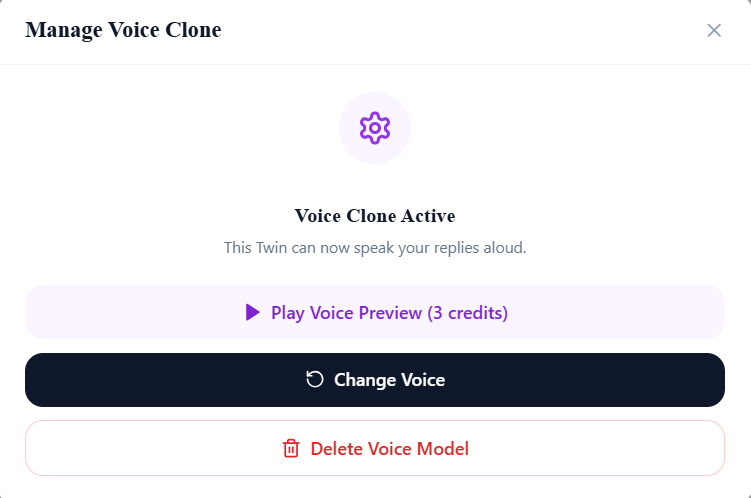
Step 3: Hear it in a real message. Once your voice is attached to your Twin, any response it gives, or any scheduled or Timeless message you choose to pair it with, can play back in your own voice rather than as text on a screen.
The First Attempt Rarely Feels Natural, and That’s Fine
Reading prompts aloud into a phone, alone in a room, is an unfamiliar thing to do. It does not feel like the way you actually talk. Most people relax into it after the first minute or two, once the self-consciousness of hearing your own recorded voice wears off.
Do not aim for a performance. The samples that end up sounding most like you are the ones read in a normal, slightly tired, end-of-day voice, not the ones read carefully like an announcement.
Why It Only Works With Your Own Consent, While You’re Here
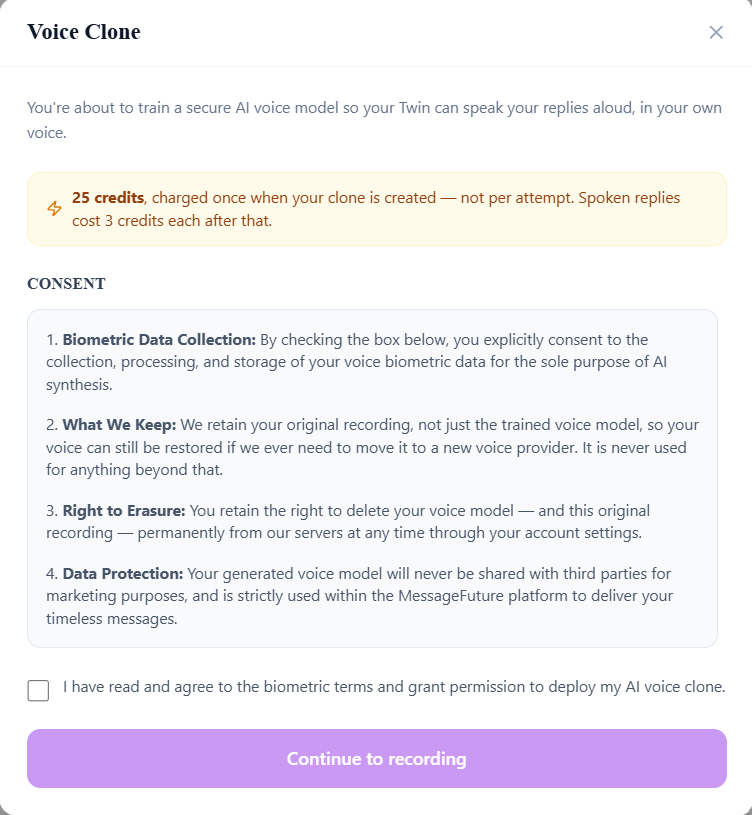
MessageFuture’s voice cloning is built around one deliberate limit: it works from your own recorded consent, given by you, while you are the one giving it. It is not designed to reconstruct a voice from old home videos or a handful of voicemails after someone is already gone.
That limit is not a technical shortcoming, it is the whole point. A voice is one of the most personal things about a person. Choosing to preserve it, on your own terms, before it is ever needed, is what makes it feel like a gift rather than an imitation.
Guardians still govern when a voice-paired Timeless message is ever delivered, the same way they govern any other Timeless message. Your voice does not go anywhere, or reach anyone, until the moment you defined actually comes.
What This Actually Sounds Like In Practice
Picture a father recording his voice into his AI Twin the year his first grandchild is born, years before that child is old enough to ask him anything directly. He is not writing a script for a specific future conversation. He is making sure that when his grandchild eventually does ask his AI Twin a question, in whatever year that happens, the answer arrives in a voice that sounds like family, not like a screen.
Or picture someone recently diagnosed with a serious illness, who wants their children to keep hearing them, not just keep records of what they said. The words matter. The voice is what makes the words feel like a person is still in the room.
Who Voice Cloning Matters Most For
Any AI Twin can be paired with a cloned voice, but three situations make the difference especially concrete. Parents who want their children to keep hearing them through milestones years away, not just read about them. People managing a serious illness, for whom recording a voice now is a way to stay present later, on their own terms, while they still can. And grandparents who want a future grandchild, one they may never meet in person, to know their family through an actual voice rather than a name on a family tree.
In every case, the mechanism is the same. The choice to record happens now, while it is still entirely the person’s own choice to make.
That is the difference voice cloning is built to make: not a new feature to explore, but a more complete version of a promise MessageFuture already made, that the people you love can still hear from you on the days that matter.
Some words are worth keeping for later.
MessageFuture lets you schedule letters, voice notes, and videos for the people you love, delivered exactly when the moment comes.
Start preserving your words →