
You remember that you achieved it. You do not remember what it felt like the day before you knew. The nervousness, the specific doubt, the exact thing you were telling yourself to get through the last stretch, all of that gets smoothed over by the time you are far enough away to tell the story. FutureMe messages exist to close that gap: a message you record today, addressed to the version of you who will read it once the goal is actually behind you.
This is the practical walkthrough: how to actually set one up, and how to time it so it arrives on the day it will mean the most.
What a FutureMe Message Actually Is
A FutureMe message is a message you send to yourself, delivered on a specific future date you choose, up to thirty years out. It uses the same scheduled-delivery mechanism as any other MessageFuture message, text, image, audio, or video, except the recipient is you.
Nothing about it requires the goal to be certain. You can record a FutureMe message the night before an exam, the week you start a business, or the day you set a five-year target, without knowing yet whether you will hit it. That uncertainty is part of what makes the eventual message worth receiving.
How to Create One
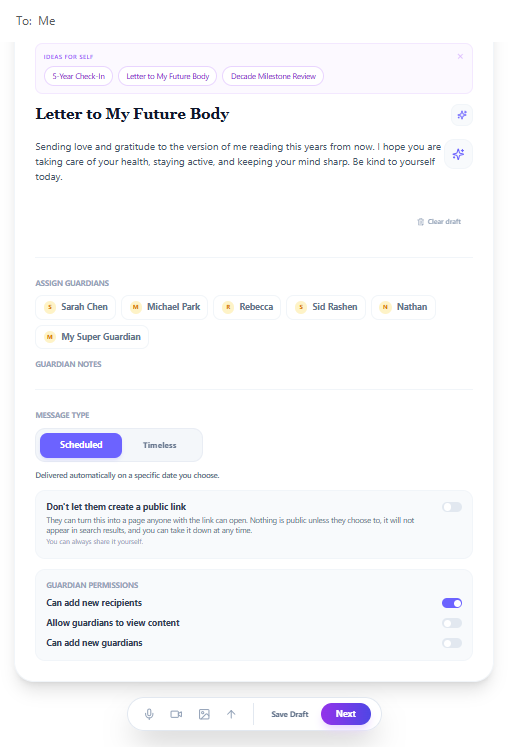
Step 1: Start a message addressed to yourself. When the recipient is you, MessageFuture surfaces a row of starter prompts, Ideas for self, things like “5-Year Check-In,” “Letter to My Future Body,” or “Decade Milestone Review.” Useful if you are staring at a blank message and are not sure where to begin, easy to ignore if you already know what you want to say.
Step 2: Write or record it. Speak or write the way you actually would to a friend, not the way you would write a caption. The specific, unpolished version is the one that lands later. Mention the small, boring details of the moment, what the room looked like, what you had for breakfast, what song was playing, since those are the details that make a message feel like a real recording of a day rather than a generic note.
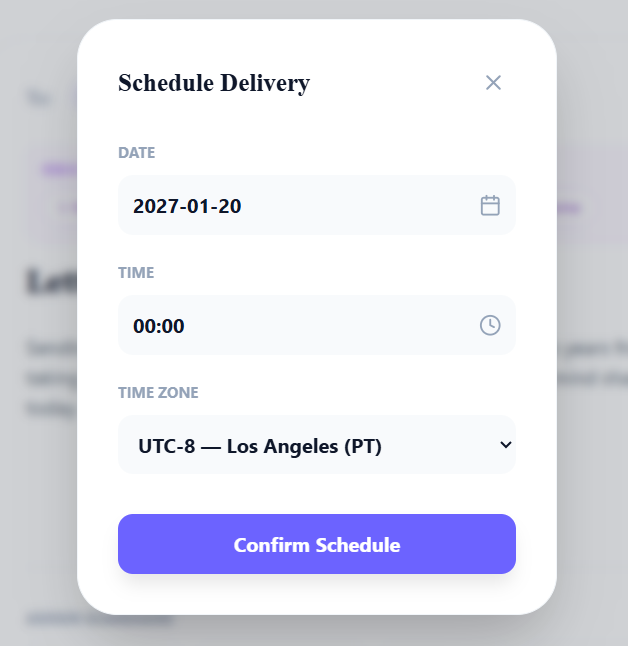
Step 3: Set Message Type to Scheduled, then choose the date. Under Message Type, you can pick Scheduled or Timeless, for a FutureMe message tied to a goal, Scheduled is what you want, delivered automatically on the specific date you set. Tapping through opens a Schedule Delivery screen where you set the date, time, and time zone.
Choosing the Right Delivery Date for a Goal
If your goal has a fixed date, a graduation, a wedding, a launch day, use it. That is the easiest case: set the delivery date to the day you already know is coming.
If your goal does not have a fixed date, a promotion you are working toward, a business hitting a certain milestone, a habit you are trying to keep for a year, pick a review date instead of a completion date. Six months from now. One year from today. The date does not need to match the exact day you succeed. It needs to be a day you will actually stop and read it.
A message with no clear delivery logic tends to get forgotten in the setup. A message tied to a specific, meaningful date gets treated like an appointment with yourself.
What If You Don’t Hit the Goal
This is the question that stops most people before they record anything. What if the business fails. What if the exam goes badly. What if the date arrives and there is nothing to celebrate.
Record it anyway. A FutureMe message is not a prediction, it is a record of where you actually were. If the goal does not go the way you hoped, hearing your own voice from the day you were still hopeful is not painful in the way people expect. It tends to be clarifying, a reminder of what you were working toward and why, from someone who could not have known the outcome yet either.
What the Research Says About Writing to Your Future Self
Hal Hershfield, a psychologist now at UCLA, has spent much of his career studying how people relate to their future selves. In a 2011 study published in the Journal of Marketing Research, Hershfield and colleagues found that people who felt a stronger sense of connection to their future self behaved differently in the present, including making better long-term decisions, because a distant future self that feels abstract is easy to discount, while one that feels concrete and specific is not.
A FutureMe message is a direct way of making that connection concrete. You are not imagining a stranger who will read this later. You are talking to a specific version of yourself, on a specific day, about a specific goal. That specificity is what the research suggests actually changes how present decisions get made.
Good Goals to Attach a FutureMe Message To
Some moments are worth this more than others. A milestone you have been working toward for months, where the version of you starting out and the version of you finishing will genuinely have different information. A decision you are still unsure about, where you want an honest record of the reasoning before you know how it turns out. A birthday or anniversary that marks a year of real change, not just a year passing.
The common thread is distance. If the version of you receiving the message will have learned something the version of you recording it has not yet learned, the message is worth making.
A Practical Example
Someone launching a small business records a FutureMe video the week they sign the lease. They talk about what they are scared of, what they cannot yet know, and what they hope is true a year from now. They set the delivery date for exactly one year out, the anniversary of the lease.
Whatever has happened by then, the message arrives. If the business is thriving, they hear exactly how uncertain that first week actually felt, a detail that would otherwise be gone. If it has not gone the way they hoped, they hear a version of themselves that was already prepared for both outcomes. Either way, the message does its job.
You can set up your own FutureMe message at messagefuture.com, and choose the day it finds you.
Some words are worth keeping for later.
MessageFuture lets you schedule letters, voice notes, and videos for the people you love, delivered exactly when the moment comes.
Start preserving your words →